

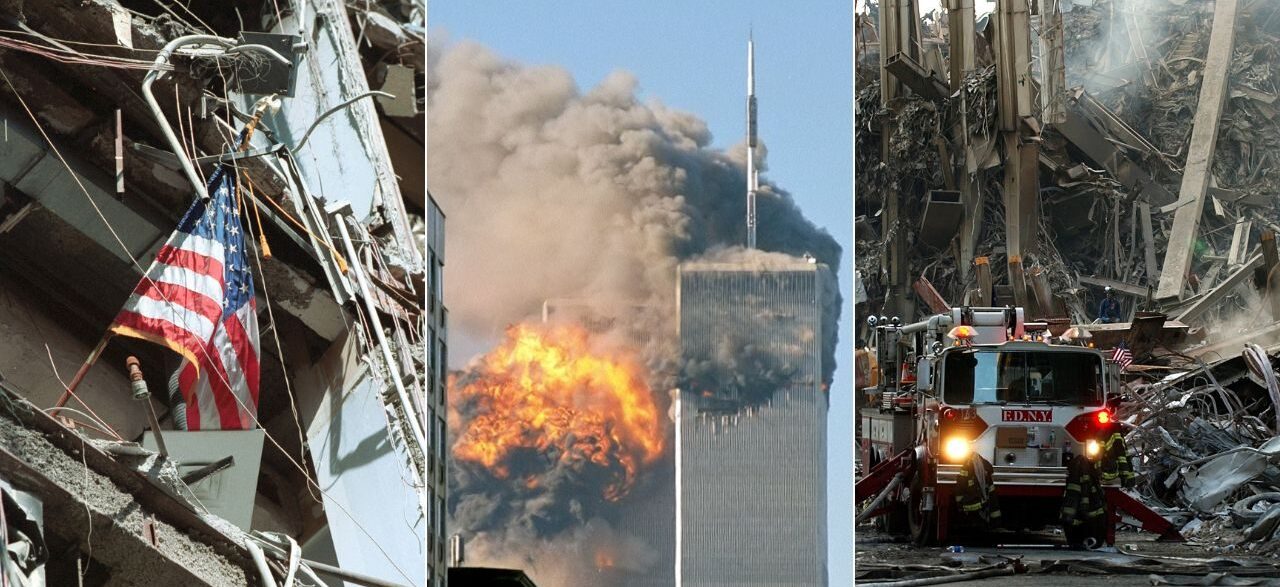
Read volume one of this series here.
11. Dale Tipton
Convention of States leader Dale Tipton was working for the FBI as a special agent in Merrillville, Indiana, when he first heard about the attack.
“We watched the planes strike the towers in disbelief,” he said. “I will always remember that day.”
Such vivid, haunting memories are typical of those who lived through that time.
Tipton’s next move, however, was anything but typical.
“Terrorism was not much of a concern at that time in Northwest Indiana, but all of that was about to change,” he described. “A Joint Terrorism Task Force was spun up quickly within the Indianapolis Field Division of the FBI, which I became a part of, working the northern part of the state.”
“I had previous counterterrorism experience of six years in the Chicago Field Office so I was transported back into that world rather quickly,” he added. “I eventually spent a month and a half assisting FBI Headquarters with leads as their extensive workload brought in agents from across the country.”
He described the overwhelming FBI response as an “all-hands-on-deck effort” — a reminder of the thousands of national security professionals who stepped up to protect our country in that exceedingly vulnerable moment.
12. Johnny “Mike” Spann
The casualties, unfortunately, did not end in New York, the Pentagon, or a field in Pennsylvania.
For Shannon Spann DeBruyn and her three children, Alison, Emily, and Jake, the nightmare redoubled on November, 25, 2001, when Johnny “Mike” Spann, their husband and father, gave his life in Afghanistan as the first American casualty in the Global War on Terror.
“Mike was deeply dedicated to his mission,” his wife fondly remembered. “He was serious and focused, but he also had a tender and kind side, especially with our children. I’ll never forget what he told Alison when she questioned why he had to go: ‘What if every daddy said, “I can’t go”? Who would protect you?’ That was how he viewed his service—not just as a duty to his country, but as a way to protect his family.”
More than seven thousand Americans have given their lives in post-9/11 military actions. How many were impelled by the same love of country and family that animated Spann?
Our readers likely remember President George W. Bush’s famous steely expression upon hearing that a second plane had hit the World Trade Center.
But who was the man who whispered the terrible news into his ear?
Andrew Card, then White House Chief of Staff, was tasked with the unthinkable. Informing the commander in chief that America was under attack may not have been a part of his job description, but Card performed the assignment with resolute professionalism and equable exactness.
Here he tells his story with the same deft precision.
“I believe that was the moment that he realized what the real job of being president was,” Card said of Bush. “He took an oath to preserve, protect, and defend the Constitution. He was, I think, realizing the magnitude of the job and the responsibility that he had.”
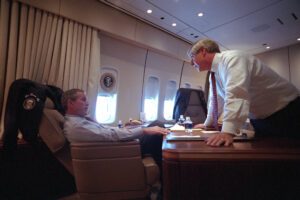
(Card with Bush later that day.)
First among Bush’s post-9/11 responsibilities, baseball may not have been top of mind. But the president’s ceremonial first pitch on October 30 — in Yankee Stadium of all places — was exactly the sort of symbolic victory America needed. In that moment, baseball was more than just a sport; it was a defiant reminder to ourselves and to our enemies that the American way of life would go on.
WATCH: Remembering President Bush’s First Pitch at Yankee Stadium After 9/11
Some heroes are born on the battlefield. Others are forged by lifting a nation’s spirit.
But the essential first heroes of 9/11 were made simply by turning back into the smoke — one last time. When no one asked them to. When they could have walked away.
Rick Rescorla was one such hero.
After leading an evacuation of 2,700 workers from the South Tower, Rescorla, a Vietnam veteran, easily could have — probably should have — called it a day. Hadn’t he done enough? For his already exemplary service, he would have been heralded as a savior. Now it was time to save his own skin.
But that was not the kind of man Rescorla was. Dutiful until the end, he stormed back into the building to look for survivors.
Needless to say, such actions cost Rescorla his life — and purchased him immortal renown.
Upon hearing a deafening explosion and smelling jet fuel, for most people, the obvious place to go was down. But not for Pablo Ortiz, Francis “Frank” De Martini, Pete Negron, and Carlos da Costa. While others were descending — or trying to descend — those four men grabbed their tools and went up. They went in search of those trapped by debris and ended up leading an estimated 50 people to safety.
Dianne DeFontes, a survivor from the 89th floor, says the impact of the plane buckled the door frames around her. Without Ortiz and his crew forcing the doors open, she would have been trapped.
Ortiz, Martini, Negron, and da Costa all died that day. Ortiz’s wife watched live on television as the tower — still holding her heroic husband — collapsed around him.
Doug Mills deserves the title of America’s photographer.
This three-time Pulitzer Prize-winning cameraman, who has covered every president since Ronald Reagan and captured the legendary photo of Donald Trump pumping his fist after the assassination attempt in Butler, Pennsylvania, also captured the aforementioned image of Andrew Card informing Bush about the September 11th terrorist attacks. This true professional spent the rest of the day with the president on Air Force One and shares his thrilling personal account of the events in this interview.
WATCH: What it Was Like on Air Force One During 9/11
18. Carlos Vega
Survivors of the carnage that claimed their colleagues’ lives have long wrestled with why they lived when others didn’t — and what sort of obligation that places on them to honor the dead.
For Carlos Vega, the answer to that question led him across the ocean and into the Middle East.
His survival story was a simple one: he was late for work.
“I was an investment banker and all I cared about was making money,” Vega said. By his own admission, he was “quite selfish.”
But as he watched New York’s first responders running towards the Twin Towers, something changed within him — “Almost feeling like maybe I can do something to help kinda thing.”
Vega gave up his financial career, joined the Army, and served three tours in Iraq. “Joining the military and serving was probably the worst thing I ever did and the best thing I ever did at the same time,” he said.
He continues to serve through a non-profit to help Chicago veterans transition back into private life.
Carlos Vega was far from the only one to switch careers in the aftermath of 9/11. Over a quarter of a million Americans joined active or reserve forces within a year of the attacks, according to the United Service Organizations.
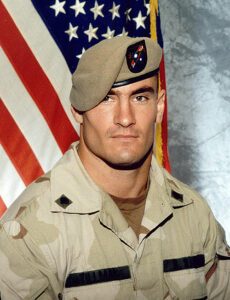
One such patriot was Pat Tillman, a rising athlete who walked away from his NFL contract for a soldier’s lowly wage. Tillman, who made the decision to enlist in the Army during his honeymoon, was tragically killed by friendly fire in Afghanistan in 2004.
John Vigiano Sr., former New York City Fire Department captain, set an example for his sons. Both of his sons followed their dad into public service: John T. Vigiano II as a firefighter and Joseph Vincent Vigiano as a NYPD detective. Both were first responders on 9/11. Both died.
The frantic desperation to find missing loved ones buried beneath the rubble, all too infrequently rewarded, compelled Vigiano Sr. to join the affectionately titled “Band of Dads” — a group of mostly retired firefighters who spent months at Ground Zero in search of their adult children, or at least their remains.
According to the 9/11 Memorial and Museum, the fathers deployed “hand shovels and small picks” to sift “through the debris, hoping to identify parts of their children. … Typically, the fathers met for morning coffee prior to their self-imposed shifts. They updated each other with radio reports as they navigated different sections of the site …. And they tried to attend the memorial services and funerals of one another’s sons.”
Vigiano Sr. knows for a fact that the last words he ever spoke to his sons were “I love you.” “So that makes me sleep at night.”
The Vigiano family’s trauma and heart for public service extend in both directions. Only eight years old when his father and uncle were killed, Joseph Vigiano Jr. has upheld the proud family tradition by serving as an NYPD officer. Earlier this week, less than two weeks before the 25th anniversary of his father’s passing, Joseph Jr. was promoted from a detective to a sergeant.
“I’m sure my dad and uncle would be proud,” he said. “My brothers and I have great families. I’m sure he’d love to see his grandkids.”
“I won’t leave you now. I can’t leave you now.”
These are the words new mother Lauren Manning says she screamed out to her 10-month-old son after her body was horrifically burned on 9/11.
Manning was running late to work that morning. The moment Flight 11 hit the North Tower, jet-fueled fire raced down the elevator shafts and erupted into the lobby, igniting her as she moved toward the elevators.
Her wounds and pain were nearly unbearable. But her will to live was invincible. Despite 82.5% total body burn injuries, Manning stubbornly resolved to fight back for her son.
“I made a choice to live,” she said.
After a month-long coma, dozens of surgeries, and relearning to walk, the indomitable Manning returned to her child and, amazingly, gave birth to a second son in 2009.
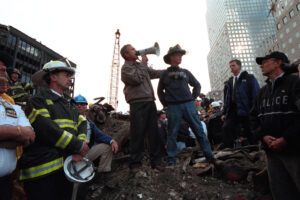
Bob Beckwith just wanted a view of the speech.
What he got was international fame.
The 69-year-old former firefighter was waiting to hear Bush’s Ground Zero address to first responders when he was approached by a Secret Service agent who alluded that he may have to give up his place for a mysterious special guest.
“I figured there goes my nice spot.”
That special guest turned out to be the president.
As Bush approached him, Beckwith, as requested by the Secret Service, prepared to step away.
“Where you going?” the president asked. I said, ‘I was told to get down.’ He said, ‘Oh no, you stay right here.’ And he put his arm around me.”
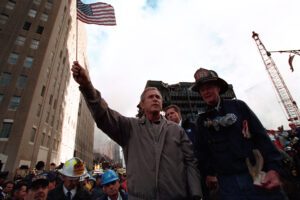
The tear-jerking speech that followed made Beckwith a national icon. (Bush let him keep the American flag that appeared on their famous Time magazine cover.)
But the millions who saw this retired firefighter’s face in the wake of 9/11 could not have known that he was dealing with his own personal tragedy. September 11 was a terrible day for Beckwith, but for different reasons. Like so many others, Beckwith watched the Twin Towers collapse in real time. Only Beckwith watched from a hospital, where he was with his grandson who had been hit by a car on the way to school that morning.
As soon as he knew that his grandson would recover, Beckwith, despite his age (and his family’s protests), took off to help at Ground Zero. He never could have guessed just how powerful his presence there would be.
Beckwith, who passed away in 2024, said President Bush generously kept in touch with him over the years, sent him hand-painted Christmas cards, and even invited him to the White House Christmas Party.
24. Brett Kulbis
Convention of States leader Brett Kulbis was underwater when he first heard the news.
The crew of the USS Key West, a Los Angeles-class submarine, heard about the attacks around the same time as everyone else. But unlike the rest of the nation, Kulbis and his colleagues did not see the video.
“For roughly the next 30 days, our connection to the events ashore came through voice reports and the occasional photograph,” recounted Kulbis, Senior Chief Petty Officer/E8 at the time. “There was no nonstop television coverage, no live press conferences, no social media updates — only fragments of information delivered across the radio. The uncertainty fed the tension aboard the boat. Scuttlebutt spread quickly, as it always does on a submarine, but this time it carried the weight of a nation under attack.”
The USS Key West received specific tasking in response to the attacks. But it wasn’t until weeks later, when several intelligence specialists came aboard, that the crew first saw the video.
“We had heard the reports. We had received a few images. But seeing the towers burning, watching the destruction unfold, and realizing the scale of the loss hit everyone differently,” remembered Kulbis. “Sailors who had spent weeks absorbing pieces of the story were suddenly confronted with the full horror of it.”
25. You
In closing, what’s your story?
Where were you on that September day?
Your story isn’t insignificant. It’s a deeply human, richly nuanced contribution to the patchwork tapestry that is our understanding of that incomprehensible nightmare.
Share it with those around you. And may we never forget.