The most common objection to an Article V convention is called the “runaway convention” objection.
It envisions a doomsday scenario in which delegates disregard the original issue, rewrite the Constitution, and change the entire American system of government. While this initial response is understandable, it is based on fear and misinformation.
Here are the facts:
There is a clear, strong single-subject precedent that would almost certainly be declared binding in the event of a court challenge
There have been over 400 applications from state legislatures for an Article V convention in the history of the Republic. No such convention has ever been called because there has never been an application from two-thirds of the states for the same subject. In addition to this, there is a huge amount of historical precedent that limits interstate conventions to a particular subject.
Ratification of any proposed amendment requires the approval of 38 states
It only takes 13 states to vote “no” to defeat any proposed amendment, and the chances of 38 state legislatures approving a rogue amendment are effectively zero.
Improper changes to the process can be legally challenged by state legislators
Courts have held that Congress acted unconstitutionally when it changed the rules of the process in midstream. See, Idaho v. Freeman, 529 F.Supp. 1107 (D.C. Idaho 1981) (vacated on the ground of mootness.) CSG’s Senior Fellow for Constitutional Studies, Michael Farris, was lead counsel for Washington state legislators in that litigation—the last major Article V case in U.S. history.
There is absolutely no historical precedent for a runaway convention
Many opponents of a convention of the states make the historically false allegation that our Constitution was adopted as the result of an illegal runaway convention. Such an argument was invented by the enemies of the Constitution and is unsupported by historical fact.
The Founders wisely included Article V in the Constitution as a powerful safeguard—a deliberate tool for the states to restore balance when the federal government exceeds its bounds. A convention of the states is one of the most controlled and accountable processes in our constitutional framework, designed specifically to empower “We the People” through our state legislatures. The Framers created the Article V convention process with numerous protections to safeguard the process and to ensure that the proper kinds of amendments are proposed at the convention:
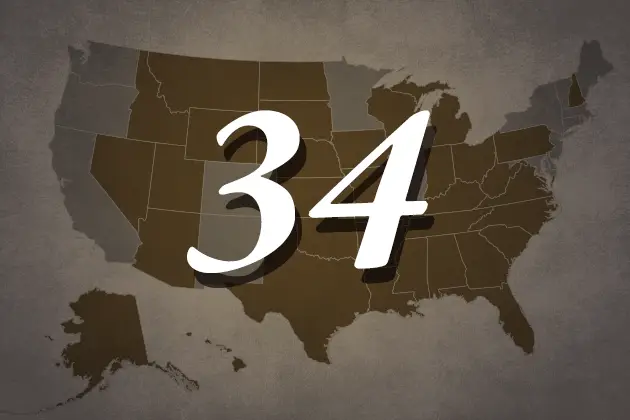
34 State Threshold
In order to trigger an amending convention under Article V of the Constitution, 34 states must pass a resolution calling for such a convention.
Identical Resolutions
Article V requires that the resolutions from 34 states be congruent—meaning they must call for a convention on the same subjects—so that the convention's scope is clearly and uniformly limited.
Limited Scope
Unlike Congress, which can propose amendments on any topic at any time, a convention of the states is limited to proposing amendments within the scope of the topics specified in the 34 resolutions passed by the state legislatures. For instance, the Convention of States Resolution limits amendment proposals to: term limits, fiscal restraints, and limitations on federal power, scope, and jurisdiction. Any amendment proposals beyond that scope would be out of order, and the parliamentarian or any single commissioner could object to their consideration.
The Authority of State Legislatures
State legislatures have the authority to recall or replace any of their commissioners who exceed their authority or instructions. This is because commissioners are the agents of their state legislature, bound by law and precedent to stay within the convention’s limited scope and their commissions given by their state legislature.
Commissioner Limitations
State legislatures can pass bills that impose criminal penalties—typically felonies—on their Article V convention commissioners if they exceed the scope of authority granted in their commission or in subsequent instructions from the state legislature.
Majority Support in Convention
Any amendments proposed in convention would require a majority vote of the commissioners, with each state having one vote. So, 26 states must vote in favor of any amendment proposal that comes out of the convention for ratification.
Ratification by 38 States
All amendments that are voted out of convention would be sent back to the states for ratification. 38 states would need to ratify an amendment in order for it to become part of the U.S. Constitution. It only takes one legislative chamber in 13 states to reject a proposed amendment.
When the Framers added Article V to the U.S. Constitution, they constructed a sound system of safeguards to protect the convention process – a process that they knew would become necessary, should our federal government become oppressive.
As Professor Robert Natelson has pointed out, “There are far more checks on a runaway convention than on a runaway Congress.”
It’s time to use the tool the Framers gave us in Article V.
The Founders wisely included Article V in the Constitution as a powerful safeguard—a deliberate tool for the states to restore balance when the federal government exceeds its bounds. A convention of the states is one of the most controlled and accountable processes in our constitutional framework, designed specifically to empower “We the People” through our state legislatures. The Framers created the Article V convention process with numerous protections to safeguard the process and to ensure that the proper kinds of amendments are proposed at the convention:
34 State Threshold
In order to trigger an amending convention under Article V of the Constitution, 34 states must pass a resolution calling for such a convention.
Identical Resolutions
Article V requires that the resolutions from 34 states be congruent—meaning they must call for a convention on the same subjects—so that the convention's scope is clearly and uniformly limited.
Limited Scope
Unlike Congress, which can propose amendments on any topic at any time, a convention of the states is limited to proposing amendments within the scope of the topics specified in the 34 resolutions passed by the state legislatures. Any amendment proposals beyond that scope would be out of order, and any single commissioner could object to their consideration.
The Authority of State Legislatures
State legislatures have the authority to recall or replace any of their commissioners who exceed their authority or instructions. This is because commissioners are the agents of their state legislature, bound by law and precedent to stay within the convention’s limited scope and the instructions given by their state legislature.
Commissioner Limitations
State legislatures can pass bills that impose criminal penalties—typically felonies—on their Article V convention commissioners if they exceed the scope of authority granted in their commission or in subsequent instructions from the state legislature.
Majority Support in Convention
Any amendments proposed in convention would require a majority vote of the commissioners, with each state having one vote. So, 26 states must vote in favor of any amendment proposal that comes out of the convention for ratification.
Ratification by 38 States
All amendments that are voted out of convention would be sent back to the states for ratification. 38 states would need to ratify an amendment in order for it to become part of the U.S. Constitution. It only takes one legislative chamber in 13 states to reject a proposed amendment.
When the Framers added Article V to the U.S. Constitution, they constructed a sound system of safeguards to protect the convention process – a process that they knew would become necessary, should our federal government become oppressive.
As Professor Robert Natelson has pointed out, “There are far more checks on a runaway convention than on a runaway Congress.”
It’s time to use the tool the Framers gave us in Article V.
CONTACT US
Whether you have a question, need assistance, or just want to share some feedback, we are here to help!
Join Us Today
Stay Updated with Our Newsletter!
Be the first to know about exciting updates, insightful articles, and more!
Support Us
Washington DC is broken and will not be fixed by the ruling elite
Your tax deductible 501(c)3 donation will enable us to win the fight against an out of control government and return power back to the sovereign citizens of the United States.