

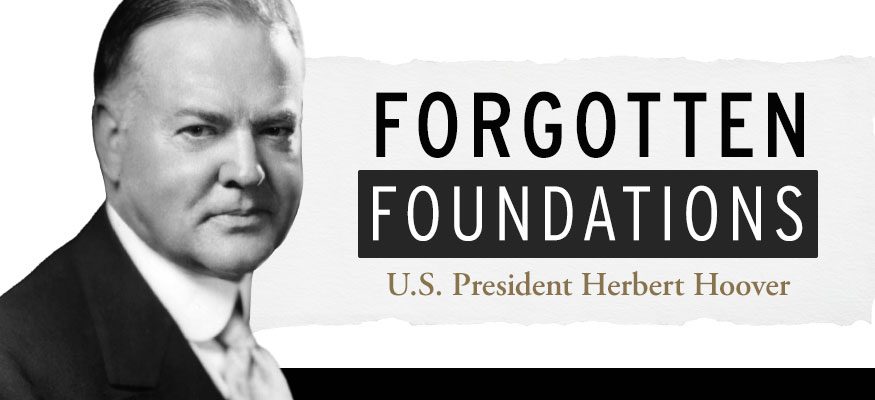
History has largely condemned Herbert Hoover’s presidency as an abject failure.
The dingy atmosphere of the images dog his legacy: shantytowns pejoratively called “Hoovervilles,” bread lines, unemployment lines, and desperate families searching for work after the catastrophic stock-market crash of 1929 and the onset of the Great Depression.
In 1932, American voters ejected Hoover from office in a landslide, choosing Franklin D. Roosevelt by more than seven million votes as the country searched for a new direction. Yet the calamity that overtook Hoover’s presidency should not obscure the remarkable life and noble ideas of the man who occupied the White House
Hoover was a brilliant engineer, businessman, humanitarian, and public servant. One of the first graduates of Stanford University, he built a successful career as a mining engineer and became wealthy via successful international business ventures. During World War I, he organized private relief efforts for civilians in Europe, leading President Woodrow Wilson to appoint him to head the U.S. Food Administration.
Hoover later served as secretary of commerce under Presidents Warren Harding and Calvin Coolidge. He helped promote the development of commercial aviation and radio in the United States, and he directed the federal response to the Great Mississippi Flood of 1927.
That background is significant when thinking about his legacy and revisiting his October 22, 1928, presidential campaign address, “Principles and Ideals of the United States Government.” Hoover was not an impractical theorist hostile to public service. He had seen government operate during war and had personally managed immense relief and administrative efforts. His argument was more precise: Government had legitimate responsibilities, but it should not assume the role of the citizen, the community, or private enterprise.
The American system
Hoover’s speech was plainly partisan. As the Republican Party’s standard bearer, he was campaigning for the entire slate and defending the party’s record after seven and a half years of Harding and Coolidge in the White House. He praised tax reductions, protective tariffs, agricultural assistance, infrastructure, veterans’ services, public health, scientific research, and other Republican accomplishments. He also criticized Democratic proposals concerning prohibition, farm relief, and hydroelectric power.
Beneath that campaign rhetoric, however, was a broader argument about the proper structure of American government. Hoover described the nation’s political tradition as “the American system,” founded on “decentralized local responsibility” and “ordered liberty, freedom and equal opportunity to the individual.” He argued that individual initiative and enterprise were not merely economic preferences. They were essential elements of self-government.
This vision was consistent with the constitutional principles established by the Founders. The American system was designed to distribute power, preserve local responsibility, limit centralized authority, and protect the freedom of citizens to govern their own affairs. Hoover believed that these safeguards were connected. When authority became concentrated in Washington, D.C., he warned, citizens would lose not only economic independence but also the habits and responsibilities that make self-government possible.
Government as umpire
The central theme of Hoover’s address was his opposition to government ownership and operation of commercial businesses. He contended that the federal government should serve as “an umpire instead of a player in the economic game.”
That distinction remains one of the speech’s most useful ideas. Hoover did not claim that government should ignore business or abandon the public interest. He explicitly defended government regulation of monopolies, public utilities, rates, services, and finances. He also supported laws to preserve competition and prevent large corporations from destroying smaller competitors.
His concern was that government would go beyond setting fair rules and become a direct participant in commerce:
“Every time the Federal Government goes into a commercial business, 531 Senators and Congressmen become the actual board of directors of that business.” No legislative body, he said, could effectively manage commercial activity because business requires “initiative, instant decision and action.”
Hoover’s case was not simply that government businesses might be inefficient. He believed that their deeper danger was political. Commercial operations require concentrated responsibility, while self-government depends on decentralization, accountability, and checks and balances. When government takes over business, he argued, political authority and economic power become intertwined. Bureaucracy expands, responsibility becomes difficult to locate, and citizens become increasingly dependent on administrators.
“Commercial business requires a concentration of responsibility,” Hoover said. “Self-government requires decentralization and many checks and balances to safeguard liberty.”
Individual freedom and bureaucracy
Hoover extended his argument beyond business performance. Much like Alexis de Tocqueville argued in Democracy in America nearly a century prior, he feared that a growing bureaucracy would change the character of citizenship itself. A government that controlled more workplaces, industries, and services would inevitably gain greater influence over the people who depended on it.
“Bureaucracy does not tolerate the spirit of independence,” he warned. Instead, it could spread “the spirit of submission into our daily life” and encourage “timid acceptance of irresistible might.”
This was not an argument against every public employee or every government program. It was a warning about dependency and concentrated authority. Hoover believed that citizens who rely upon any government for their livelihoods could become vulnerable to political pressure. Government employees might become a political machine, he suggested, or face restrictions on their political rights to prevent that outcome. In either case, the expansion of government could weaken the independence that free citizens require.
He also connected economic freedom to freedom of speech and political liberty. “Free speech does not live many hours after free industry and free commerce die,” he declared. In Hoover’s view, this was because control over economic life would eventually create pressure to control the press, public debate, and political opposition.
Not laissez-faire
Hoover took care to distinguish his position from an “every man for himself” philosophy. “It is no system of laissez faire,” he said. Individualism required more than the absence of government interference. It required equal opportunity, economic justice, and protection against domination by “any group or combination,” whether business or political.
He supported government action for flood control, navigation, irrigation, scientific research, national defense, and the development of new technologies. In those cases, government might produce power or commodities as a by-product of a legitimate public purpose. But, he insisted, such commercial activity should not become the government’s primary purpose.
Such a distinction resonates today. The question Hoover raised was not whether government should ever act. It was whether government action would preserve the capacity of citizens and communities to act for themselves. His preferred model was a government strong enough to protect the public interest, but restrained enough to leave room for initiative, competition, local responsibility, and private association.
A relevant warning
Events soon overtook Hoover’s presidency. The calamitous stock-market crash of October 1929, the Great Depression, and the suffering of millions of Americans accelerated disdain for his administration. Roosevelt’s victory in 1932 ushered in a dramatic expansion of the federal government and permanently changed the relationship between Washington, D.C., and the American people.
Still, Hoover’s lackluster term in office do not erase the questions he posed before the crisis. How much authority should government exercise over commerce? When does assistance become dependence? Can a nation preserve political freedom while placing more of daily economic life under centralized control?
Hoover concluded with a deeply personal vision of national purpose. He imagined an America where people could live “in ordered freedom,” build secure homes, raise their children, and enjoy opportunity not concentrated in the hands of a few but “spread through the lives of all.”
While that vision was partisan in its original setting, its foundation was not. It rested on self-government, limited and accountable authority, equal opportunity, and the belief that free citizens must remain the primary agents of their own prosperity.
In an era when federal power reaches into nearly every facet of life, Hoover’s warning remains worth remembering: Government should protect the conditions of liberty without becoming the master of the people it was created to serve.