

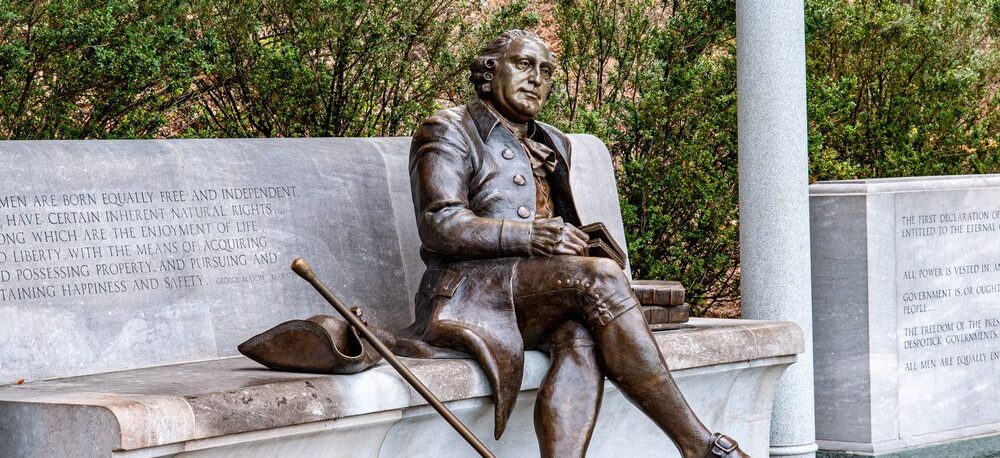
In all our associations; in all our agreements, let us never lose sight of this fundamental maxim—that all power was originally lodged in, and consequently is derived from, the people. We should wear it as a breastplate and buckle it on as armor. We have received [rights] from our Ancestors and, with God’s Leave, we will transmit them, unimpaired to our Posterity. – George Mason
Gentlemen, we have made a grave mistake.
That’s probably not what the delegates who were prepared to sign the new Constitution wanted to hear.
But as George Washington solemnly observed a month after the 1787 Constitutional Convention adjourned: “The Constitution…is not free from imperfections.”
The Founding Fathers were ardent believers in human fallibility. They naturally assumed that the new Constitution represented, in the words of Alexander Hamilton, “a compound … of the errors and prejudices” of the men who drafted it. Benjamin Franklin, like his colleagues, endorsed the document not because it was perfect, but “because I expect no better….”
Fortunately, George Mason detected and expunged one of the document’s most glaring defects and bluntly warned his colleagues about it just days before the convention ended.
George Mason — Of the First Order of Greatness
The influential Virginia statesman has long been denied his proper place in history. In addition to authoring the 1774 Fairfax Resolves, which challenged Great Britain’s long string of constitutional abuses, Mason also helped write the Virginia Declaration of Rights and the Constitution of Virginia, both of which set the tone for America’s Founding Documents. Indeed, Mason’s assertion “That all men are by nature equally free and independent and have certain inherent rights” directly influenced Thomas Jefferson’s Declaration of Independence.
As Jefferson himself affirmed, “The fact is unquestionable, that the Bill of Rights, and the Constitution of Virginia, were originally drawn by George Mason, one of our greatest men, and of the first order of greatness.”
Unsurprisingly, given Mason’s impressive résumé, his words carried great weight at the Constitutional Convention.
Many of Mason’s fellow delegates initially doubted the need for a constitutional amendment clause. This was astonishing, for as historian David E. Kyvig has noted, it was a “combination of constitutional inadequacy and inflexibility that had produced the governmental crisis [the Framers] were confronting” under the hopelessly defective Articles of Confederation.
Article XIII of the Articles had inexplicably blocked “any alteration at any time” “unless such alteration be agreed to in a congress of the united states, and be afterwards con-firmed by the legislatures of every state.” This absurd unanimous threshold for amendment made it nearly impossible to correct the many defects that had emerged under that system. Mason wanted to change that.
The Fight For an Amendment Process
Acutely aware of the convention’s inevitable imperfections, Mason warned that the “plan now to be formed will certainly be defective as the Confederation has been found on trial to be. Amendments therefore will be necessary, and it will be better to provide for them in an easy, regular, and constitutional way than to trust to chance and violence.”
Mason’s speech galvanized support for a formal amendment process, and on August 6, the convention quietly adopted a preliminary draft of Article V:
“On the application of the Legislatures of two thirds of the States in the Union, for an amendment of this Constitution, the Legislature of the United States shall call a Convention for that purpose.”
Notably, this version of Article V reserved the power to initiate an amendment exclusively to the states. Exactly a week before the Constitutional Convention adjourned, Alexander Hamilton complained about this.
He agreed with Mason “that an easy mode should be established for supplying defects which will probably appear in the New System.” However, he argued, there could be no harm in granting Congress an equivalent power to propose amendments, provided that “the people” were responsible for ratifying amendment proposals.
The delegates considered allowing for the national legislature to “propose amendments to the several States for their approbation [approval],” adding that “no amendments shall be binding until consented to by two thirds [emphasis added] of the several States.” This time, however, concerns about an immoderately lax amendment process surfaced, and the measure narrowly failed. James Wilson countered by raising the threshold for ratification to “three fourths of the several States.” His proposal “was agreed to nem: con” — without debate.
Subsequently, James Madison cobbled together the convention’s various proposals into a nearly complete draft, seconded by Hamilton:
“The Legislature of the U. S. whenever two thirds of both Houses shall deem necessary, or on the application of two thirds of the Legislatures of the several States, shall propose amendments to this Constitution, which shall be valid to all intents and purposes as part thereof, when the same shall have been ratified by three fourths at least of the Legislatures of the several States, or by Conventions in three fourths thereof, as one or the other mode of ratification may be proposed by the Legislature of the U S:”
But not everyone was satisfied.
Ever protective of the states, Mason noticed, much to his horror, that the convention had somehow dropped the clause allowing for the states to initiate the amendment process.
This, he warned, was “exceptionable & dangerous,” defying the basic logic of the Framers’ Republican conception of checks and balances.
It was naive, he protested just two days before the Convention ended, to believe that an “oppressive” government would ever propose “the proper kinds” of amendments to restrict its own tyranny. It would thus be essential to entrust the states with an equivalent power to propose amendments as an emergency check on a runaway Congress.
Once again, Mason’s words carried great weight.
Gouverneur Morris and Elbridge Gerry moved “to amend [Article V] so as to require a Convention on application of 2/3 of the Sts,” and the Article V convention clause was agreed to “nem: con.”
This proposal to allow two-thirds of the states to trigger a limited-purpose convention of the states to propose constitutional amendments, which would then go back to the state legislatures for three-fourths approval, served as the linchpin to the Framers’ many debates about amending the Constitution. It was also the answer to the Anti-Federalists’ fear that the national government would be “disinclined to yield up any portion” of its authority. As Hamilton wrote,
“By the fifth article of the plan, the Congress will be obliged ‘on the application of the legislatures of two thirds of the States … to call a convention for proposing amendments ….’ The words of this article,” he noted, “are peremptory. The Congress ‘shall call a convention.’ Nothing in this particular is left to the discretion of that body. And of consequence, all the declamation about the disinclination to a change vanishes in air. … We may safely rely on the disposition of the State legislatures to erect barriers against the encroachments of the national authority.”
The statesman from Virginia ultimately withheld his signature from the Constitution — a move that cost him politically and personally. But 239 years later, his contributions have proven a lifeline to those who now live under exactly the kind of “oppressive” government that Mason warned about.
The Need For a Convention Today
Washington, D.C., today has amassed over $40 trillion in national debt. Members of Congress stubbornly override the will of the people, nearly 90% of whom support congressional term limits. The federal government continues to overstep its constitutional bounds, and it will never rein itself in.
Mason, who knew as well as anyone that the new constitutional system was fallible, foresaw this. He knew the day would inevitably come when the federal government disregarded its constitutional bounds, and he wanted the people and the states to have the power to propose amendments at an Article V convention to rein it back in. Thanks to Mason’s advocacy at the Constitutional Convention, we now have the opportunity to act through our states to propose amendments to impose term limits and fiscal restraints on Washington, limit the power, scope, and jurisdiction of the federal government, and restore the proper balance of power.
History may have largely forgotten George Mason’s name, but it has vindicated his bold stand for government of, by, and for the people, his case for a formal amendment process, and his last-minute effort to save the United States Constitution from what would have been a grave mistake.
As the curtain closed on the convention in Philadelphia, George Washington retained a few doubts about the document’s lingering imperfections. But there was hope in the form of Article V:
“[A] Constitutional door is opened for future amendments and alterations.”