

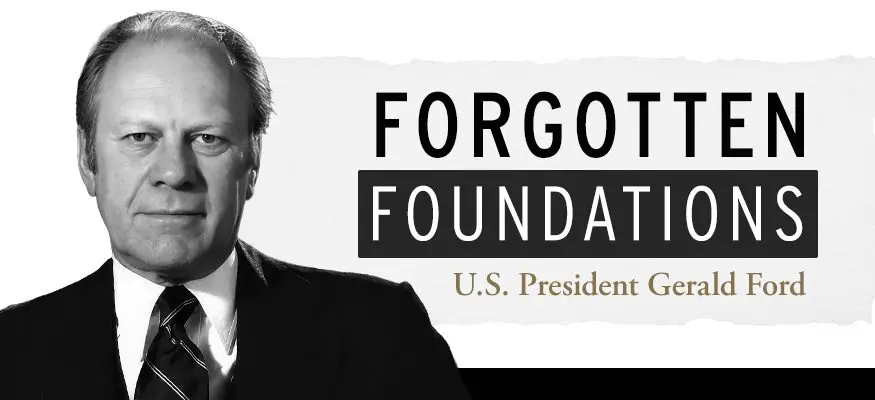
Gerald Ford became president under totally unfamiliar circumstances.
On August 9, 1974, as he took the oath of office following Richard Nixon’s resignation, Ford stepped into a constitutional moment without precedent. The Founders had contemplated death, incapacity, even removal and resignation.
But the latter had never happened.
In that sense, Ford’s address to the nation that day stands as a quiet but essential reaffirmation of the American experiment in self-governance.
For nearly 185 years, the presidency had endured shocks that might have broken weaker systems or government. The British burned the White House in 1814. The nation fractured in the Civil War. Economic collapse brought the country to its knees during the Great Depression. Two world wars tested the strength of American institutions and the resilience of its people. Yet through it all, no president had resigned. The office remained, in a sense, unbroken – until the Watergate scandal forced a reckoning.
Ford assumed office in the aftermath of that rupture, at a time when public trust in government had eroded dramatically. The late 1960s and early 1970s had already left the nation strained: civil unrest, assassinations, and the long shadow of Vietnam had created a pervasive sense that the country was coming apart at the seams. Nixon’s resignation did not only prematurely conclude a presidency – it intensified a crisis of confidence in the very legitimacy of American governance.
A Daunting Task
As George Washington did in 1789, Ford faced a blank page. There was no script for what a president should say upon assuming office through resignation. Washington had to define the tone and expectations of a new republic. Ford had to reassure a weary nation that the republic still functioned.
He began with disarming candor:
“I am acutely aware that you have not elected me as your President by your ballots.”
In fact, Ford had not even been elected vice president. He had been appointed to that office less than a year earlier, following Spiro Agnew’s ignominious resignation, and confirmed by Congress under the 25th Amendment. No individual had ever assumed the presidency under such circumstances.
This was an important acknowledgment. Ford did not attempt to cloak himself in borrowed electoral legitimacy. Instead, he grounded his authority in the Constitution itself. His presidency, he implied, was not an aberration but a demonstration of constitutional design functioning exactly as intended.
In what may be the most important line of the speech, Ford declared that “Our Constitution works; our great Republic is a government of laws and not of men. Here the people rule.”
This was the true heart of his message.
Ford articulated a foundational principle that traces directly to the Framers: the durability of institutions over individuals. The American system does not depend on the virtue or longevity of any single officeholder. It depends upon a framework of laws, checks, and orderly processes that ensure continuity even in moments of crisis.
That this principle had been tested and proven in real time was no small matter. Around the world, political systems often snap under similar strain. Leadership crises can lead to instability, power struggles, violence, or even collapse.
The United States, by contrast, witnessed the peaceful transfer of power under extraordinary circumstances – without violence, without constitutional breakdown, and without interruption to the functioning of government.
Making it Plain
Ford’s demeanor reinforced the message. He was not a soaring orator, and he did not pretend to be one. “I am a Ford, not a Lincoln,” he would later say with characteristic humility. His style was plainspoken and understated – very much of the Midwest. That quality served him and the country well. The moment did not call for rhetorical flourish; it required steadiness and sincerity.
In popular culture, the best-remembered line from his August 9, 1974, address remains his allusion to the Watergate saga: “Our long national nightmare is over.” It was even used as a form of self-deprecation by late night talk show host David Letterman, who arranged for George H.W. Bush, Bill Clinton, George W. Bush, and Barack Obama to prerecord video of the former presidents saying the phrase to be played on Letterman’s broadcast finale.
In the years that followed, Ford’s presidency would be remembered for other things, some of them less than flattering. Despite his all-American football career at the University of Michigan, he was parodied by Chevy Chase as a clumsy oaf on “Saturday Night Live”. Ford’s “Whip Inflation Now” campaign turned into a ham-fisted mess.
Ford’s 1976 presidential campaign struggled to unify a divided Republican Party, and Ronald Reagan’s near-upset – and memorable convention speech that came at the fateful behest of Ford himself – cast a long shadow over Ford’s leadership and left many members of the Republican Party thinking that they had nominated the wrong candidate.
But such perceptions should not obscure the significance of August 9, 1974. In that address, Ford accomplished something both simple and profound: he restored a measure of confidence in the constitutional order at a time when it was most in doubt.
He did not claim to heal the nation overnight, nor did he offer grand promises. Instead, he placed his faith – and asked the American people to place theirs – in the enduring framework of self-governance. His message was not that the system was flawless, but that it was resilient: much like Ford himself.
The Precedent
In doing so, Ford established a precedent for future moments of unexpected transition. While no subsequent president has assumed office following a resignation, the principle he affirmed remains relevant. Presidents may leave office under a variety of circumstances, but the continuity of governance must always be preserved.
Ford’s speech demonstrated how that continuity can be communicated: with humility, with honesty, and with a clear appeal to first principles. It showed that legitimacy in such moments does not derive solely from elections, but from fidelity to the Constitution and the rule of law.
Today, the address is often remembered for that single phrase about a “long national nightmare.” Yet its deeper significance lies in its quiet insistence that the American system works, even when tested in ways the Founders could scarcely have imagined.
In that sense, Gerald Ford’s remarks on August 9, 1974, belong firmly among the “forgotten foundations” of the republic. They remind us that self-governance is not sustained by personalities, but by principles, and that even in moments of profound uncertainty, those principles can still hold firm.
Watch Gerald Ford take the oath of office and address the nation in the most unique of circumstances by clicking below: