

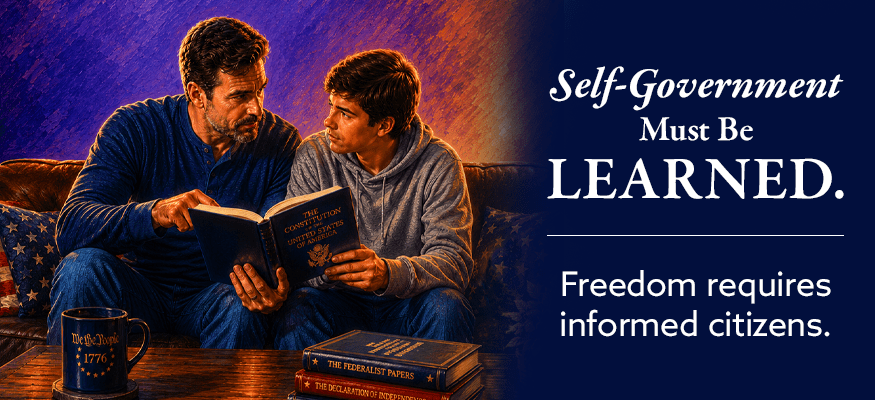
Self-government in a representative republic like the United States sounds simple.
The people rule. The people decide.
But in real life, it is not automatic or simple. Self-government has to be learned.
That is where we face a serious problem today. Americans are expected to take part in self-government, yet most were never taught how it works. We urge people to vote, to stay informed, and to hold leaders accountable. But we often skip the step where we explain how to do those things well.
This creates a gap between what we expect and what we prepare people to do.
First, we expect what we do not teach. Many students leave school without a clear idea of how laws are made, what the Constitution says, or how citizens can influence their government. They may know a few facts and dates, yet lack a working understanding. Then we are surprised when people feel confused, frustrated, or disconnected. If the goal is strong participation, we must teach the fundamentals of how our system works.
Citizenship is a skill that also must be learned. Just like reading or writing, it takes practice. People need to know how to ask good questions, how to find reliable information, and how to speak up in respectful and effective ways. They need to understand the role of local, state, and federal government. These are not talents people are born with. They are skills that are built over time.
When people learn these skills, they are more confident. They are more likely to engage. They begin to see that their voice matters. That is when self-government starts to come alive.
Third, we cannot preserve what we do not understand. Freedom is not self-sustaining. It depends on citizens who know what makes it work. If people do not understand the principles behind our system, they are less able to protect it. Over time, that can lead to lost freedoms and weaker institutions.
This is why civic education is not just a school subject. It is an investment in the future of our republic. When we teach the next generation how self-government works, we are building a stronger, more stable nation. We are preparing citizens who can think clearly, act responsibly, and defend their freedoms.
The connection is simple. Knowledge leads to responsibility. Responsibility supports freedom. And freedom depends on active, informed citizens.
The good news is that this can be fixed. Families, communities, and organizations like Convention of States Foundation all have a role to play. We can teach the basics. We can encourage participation. We can model what good citizenship looks like in everyday life.
Self-government is not a given. It is a responsibility passed from one generation to the next. If we want to keep it, we have to teach it, practice it, and invest in it.
That work starts now. Sign the Liberty Pledge and learn more about how you can pass along the gift of self-governance to future generations.