

It’s almost as if the Founding Fathers of the United States of America had a crystal ball in front of them in Philadelphia during the summer of 1787.
It’s almost as if they could see that one day members of Congress would hang around for decades on end, piling up power and wealth at the expense of the Treasury and the people.
It’s almost as if they could see that a government unwilling to exercise self-discipline and self-governance would run up massive debt.
It’s almost as if they could see that such a mindset would lead not only to a reluctance, but an outright refusal, to curtail their own influence and sources of income.
Of course, they didn’t have a crystal ball. But they were among the most intelligent and well-read individuals ever to grace this continent. They understood human nature and anticipated the warning later captured in Lord Acton’s famous words: “Absolute power corrupts absolutely.”
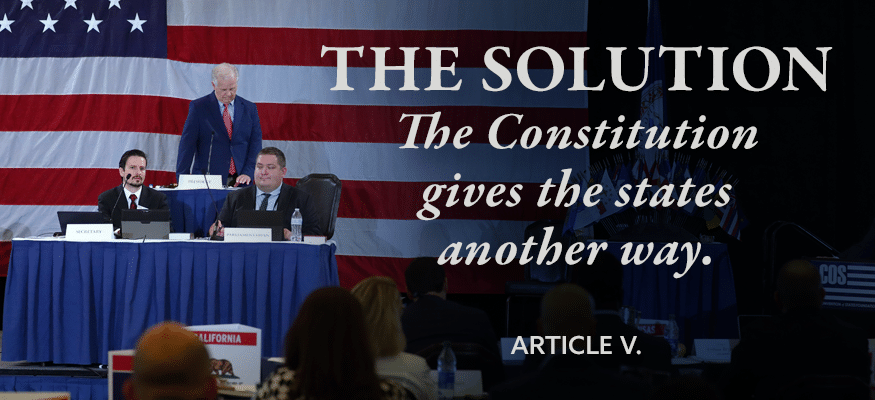
That’s why they, spurred by George Mason, the principal author of the Virginia Declaration of Rights, included an invaluable clause in Article V of the Constitution. It gives the states a path to righting the ship of state when it comes unmoored and threatens to sink altogether.
Mason saw the problem
As the Constitutional Convention neared its end in Philadelphia, Mason raised a concern that remains easy to understand today.
What would happen if the federal government needed reform, but Congress stood in the way?
On September 15, 1787, Mason objected to an amendment process that depended on Congress to propose changes, even when the states requested them. According to James Madison’s notes, Mason warned that “no amendments of the proper kind would ever be obtained by the people, if the Government should become oppressive.”
The problem was simple: Those who held power might refuse to support changes that would limit it.
Gouverneur Morris and Elbridge Gerry then moved to require a convention upon the application of two-thirds of the states. The motion passed without opposition. The Constitution would give the states another way to propose amendments, rather than leave that authority entirely with Congress.
Mason did not need to predict today’s headlines. He needed only to recognize a lasting truth about human nature: People entrusted with power cannot always be counted upon to surrender it.
Two paths, one Constitution
Article V provides two ways to propose constitutional amendments.
Congress can propose amendments when two-thirds of both the House and Senate agree. Good luck with that.
The other route begins with applications from two-thirds of the state legislatures, or 34 today. Article V says Congress “shall call a Convention for proposing Amendments” when that threshold is met.
Shall is the keyword. The Constitution directs Congress to call the convention. The states do not have to persuade two-thirds of Congress to support the amendments they want considered. A convention provides a separate route for proposing them.
This does not mean Congress has no role. It calls the convention and chooses which of the Constitution’s two methods the states will use to consider ratification. But Congress does not write or propose the convention’s amendments.
That distinction is the heart of Mason’s concern and the answer that the delegates adopted.
The people, working through their states, would have a constitutional path forward even when federal lawmakers had little interest in reform.
The other path
Consider the question of congressional term limits.
A term limits amendment would ask members of Congress to accept a constitutional boundary on how long they could serve. It is easy to see why lawmakers who hope to remain in office might resist such a change.
The same tension can arise when Americans seek firmer limits on federal spending or federal authority. Reforms intended to restrain Washington may face resistance from the very officials whose power they would restrict.
The Convention of States effort focuses on three categories of proposed amendments: fiscal restraints, limits on federal power and jurisdiction, and term limits for federal officials. These are the subjects its state applications seek to bring before a convention.
Of course, not every proposal will succeed or every delegate will agree. The point is that the Constitution provides a place for the states to consider reforms without waiting for Congress to propose them.
Proposals are not amendments
One final distinction is essential: An Article V convention proposes amendments. It does not and cannot amend the Constitution.
Any proposed amendment must still receive approval from three-fourths of the states, or 38 today. That requirement applies whether the proposal comes from Congress or a convention.
Article V therefore provides both an opportunity for change and a demanding test of support.
The Founders did not leave future generations with only a choice between accepting federal overreach and abandoning the Constitution. They included a lawful way to seek correction within it.
To explore that design, visit Convention of States Foundation’s Article V educational resources.