

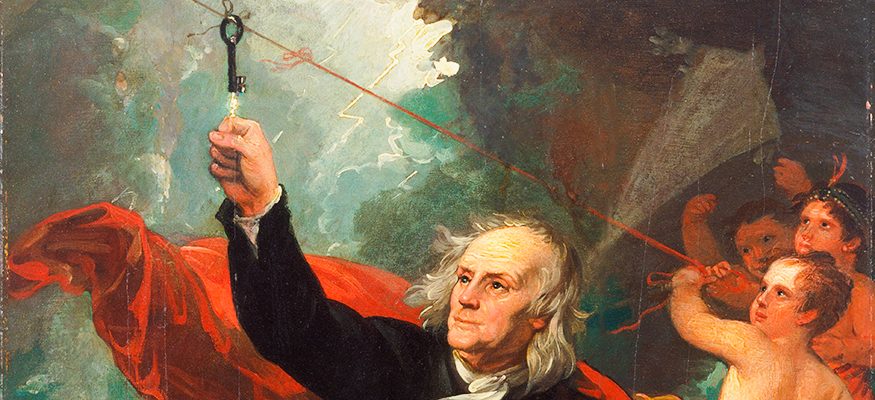
Americans are known for their innovative spirit.
From Benjamin Franklin’s electricity experiments to the Wright brothers’ airplane and Alexander Graham Bell’s telephone, American ingenuity is a virtue, and one that we should perpetuate.
Few would question that our Constitution is one of America’s greatest innovations: a work of pure genius, crafted by men who understood that, because human nature is corrupted, a system of checks and balances is essential to good government. Crucially, the Framers expected every one of those checks and balances to be used.
One of the Constitution’s most significant checks and balances is the Article V convention for proposing amendments. This process was added so the states could intervene if Congress became overbearing and needed to be restrained.
When you look at the condition of the federal government today, you have to wonder why the states have never used this check. Our national debt is unconscionable and unsustainable. Unaccountable bureaucrats are crushing American innovation with mountains of regulations, even though Article I requires laws to be made by Congress.
These are just a few examples of the countless ways in which the federal government has overstepped its bounds. That overreach is now baked into the system through written, formal court precedent.
Article V convention opponents love to argue, “The Constitution is not the problem. The problem is that public officials refuse to obey it.”
That statement is ridiculously simplistic.
Certainly, if federal officials interpreted the Constitution according to the Founders’ original intent — what the words meant when they were written — things would be better. But the question before us is this: once precedent establishes that the Constitution may be interpreted another way, how do we fix it?
Elect better people? We have been trying that for decades. It does not work, for the reason the Founders knew it would not work: people in power want to keep as much power as possible. Better people in Congress will not close the loopholes that have been opened in our Constitution. Even if they wanted to, they cannot undo precedent.
The state-led Article V convention process is the answer.
Consider an amendment that was used to correct an imbalance of power: the Eleventh Amendment. It was proposed by Congress and ratified by the states specifically to reverse the Supreme Court’s decision in Chisholm v. Georgia, which had given federal courts more jurisdiction than they should have had. With one simple amendment, the problem was corrected clearly and permanently.
The Eleventh Amendment says, “The Judicial power of the United States shall not be construed to extend to—” and then continues. Now imagine an amendment today, proposed by the states at a convention, that reads: “The General Welfare Clause shall not be construed to empower Congress to tax and spend for—” Fill in the blank.
The Convention of States application, now passed in 20 states, seeks to propose constitutional amendments that impose fiscal restraints on Washington, D.C., place additional restraints on its power, and set term limits for federal officials and bureaucrats. We need 34 states to convene the meeting, and any proposals must be ratified by 38 states — a very high bar.
This is not about “opening up” the Constitution. It is not about “rewriting” the Constitution. In a single sentence, Article V gives a convention the same power it gives Congress: the power to propose amendments to the Constitution we already have.
Some people oppose our efforts because they like big government. But for those who support our goals while continuing to oppose this effort, we need to make sure they understand that what they fear is nothing more than a meeting where states make suggestions. Those opponents need to own the fact that the process they oppose is part of the Constitution they claim to revere — the Constitution our legislators took an oath to uphold.
People who refuse to support an Article V convention because they fear a “runaway convention” — a mythological event with zero basis in history and zero basis in logic — might as well refuse to leave their homes in the morning because they fear a giant sinkhole could swallow them. This is not how patriots or people of faith make decisions.
While America is known as a land of courage, innovation, and ingenuity, she has always had fearful doubters. Out of fear, many colonists refused to support the cause of their own self-government, choosing loyalty to Great Britain instead. Those fearful doubters are still among us today.
But let us be clear: rejecting an Article V convention out of loyalty to the Constitution is an oxymoron. In rejecting a convention, they are rejecting the Constitution. Their motive is fear, and it is diametrically opposed to the spirit of courage and innovation that made America great.
For our part, we choose action. We choose to trust in the process our Constitution provides. And we choose to trust our Almighty Creator, who holds the affairs of nations in His hands.
We choose to join the ranks of those who step forward to do the work, rather than those who criticize from the sidelines.