

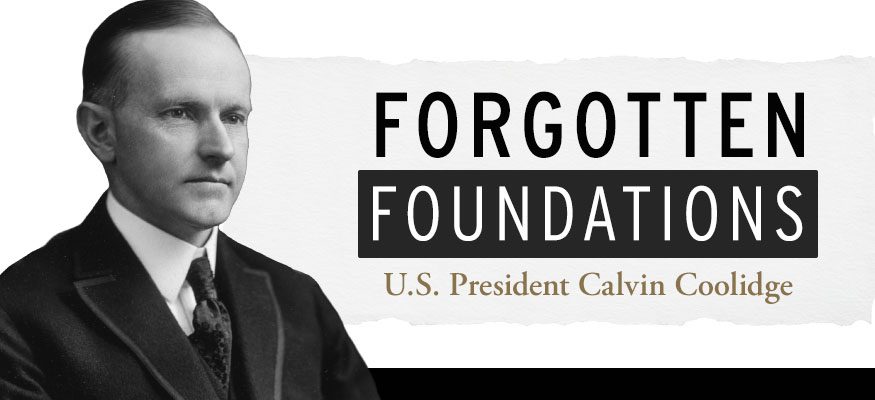
On November 3, 1924, the night before Americans were to select their next president, Calvin Coolidge addressed the country by radio from the White House.
His own name was on the ballot. He was still reeling from the sudden death of his sixteen year-old son, Calvin Coolidge, Jr., earlier that summer. As such, “The Duties of Citizenship” is notable on one hand for what Coolidge did not say. He did not ask Americans to return him to office, nor did he utter the names of his opponents or acknowledge his searing pain.
Instead, Coolidge asked his listeners to fulfill an obligation more enduring than any campaign or presidency: to govern themselves.
As Americans head to the polls in 2026, that truth deserves another hearing.
The 1924 campaign
In the words of Coolidge biographer Robert Sobel, the incumbent’s 1924 presidential campaign was “both unusual and dull.”
Coolidge did not actively campaign. In fact, he didn’t even mention his opponents (Democratic Party nominee John W. Davis and the Progressive Party’s Robert M. La Follette) in various speeches given during that year which instead examined weighty issues and concepts such as religious liberty, world peace, and, indeed, self-government.
While this strategy was in line with Coolidge consistency (he operated in the same manner when running for state offices in Massachusetts), a great deal of his seeming ambivalence was likely due to mourning the inexplicable death of his son. Coolidge himself would write in his autobiography that when his son died of sepsis after contracting a blister on a toe while playing tennis, “the power and glory of the presidency went with him.”
Vice President Charles G. Dawes was dispatched to the campaign trail and a greater contrast to Coolidge could hardly be found. Dawes traveled the nation with stamina and style, logging over 1,500 miles in four months and giving more than a hundred speeches. Historian Robert Murray wrote that Dawes had a delivery that was “electric. It was said that he was the only man in the world who when he spoke could keep both feet and both arms in the air at once.”
While Coolidge was no doubt relieved to be exempt from the rigors of a presidential campaign, he was not completely silent. In fact, he took full advantage of what was at that time the greatest instrument of mass communication known to the world.
No radio silence from Cal
Franklin D. Roosevelt is most closely associated with the radio because of his “fireside chats”, but Coolidge was the first president of the radio age.
As Sobel notes, “Coolidge had a small, reedy voice, which together with precise New England pronunciation, was a drawback on the stump, but advantageous on radio.” A contemporary article published in The New York Times stated that “the president…adapted himself to the new science” of radio.
Coolidge knew it was perfect for his subdued demeanor and approach. He told Indiana congressman James Watson that “I am very fortunate that I came in with the radio. I can’t make an engaging, rousing, or oratorical speech to a crowd…but I have a good radio voice, and now I can get my messages across to them without acquainting them with my lack of oratorical ability or without making any rhetorical display in their presence.”
Radio truly was the ideal match of man and medium for Coolidge. He intended to take full advantage as he addressed the nation in a manner and style that only he could or would on the eve of the 1924 election.
The responsibility that cannot be delegated
“The institutions of our country rest upon faith in the people,” Coolidge began. But his confidence was not an invitation to complacency. Faith in the people required each person to accept responsibility for the republic’s welfare. “The right action of all of us,” he explained, “is made up of the right action of each one of us.”
Too many Americans have given in to the temptation of expecting someone else to preserve what is casually neglected. Citizens cannot refuse their own duties and reasonably expect their neighbors to rescue them from the consequences.
For Coolidge, voting was the immediate test. It was a function that could not be delegated or postponed. That election’s opportunity would not return. When an eligible citizen passed on it, the loss belonged not merely to the individual but to the nation.
His argument elevated the ballot above personal preference. Voting was not simply an opportunity to express satisfaction or frustration. It was an obligation arising from membership in a self-governing people.
Sovereignty must be exercised
Coolidge then connected individual conduct to the survival of republican government. Public opinion might influence presidents, legislators, and even courts, but the ballot box gave the people a decisive means of directing their government.
“The people of our country are sovereign,” he declared. “If they do not vote they abdicate that sovereignty.” The danger was not that power would disappear. It was that “other forces will seize it.” Citizens who would not govern themselves could expect someone else to govern them.
This is the speech’s central warning. Constitutional institutions provide opportunities for self-government, but they cannot supply the public spirit necessary to sustain it. A republic does not remain genuinely self-governing merely because its citizens retain the legal right to participate. That is the case even if, as Coolidge said, “America, more thoroughly than any other country, has adopted a system of self-government.”
Coolidge’s understanding of freedom was therefore active rather than passive. “The only way to be free,” he said, was to exercise freedom’s privileges energetically and discharge its duties faithfully. Liberty required action, not the comforting assumption that someone else would keep it secure.
An informed vote, not merely a vote
Participation alone was insufficient. “To live up to the full measure of citizenship,” Coolidge insisted, required “intelligent action.” Americans needed information, education, and the humility to continue learning after leaving school.
He offered a demanding definition of political campaigning that in today’s world of petty attack ads featuring sound bytes might seem like a transmission from another planet: “The purpose of a campaign is to send an intelligent and informed voter to the ballot box.” Speeches, literature, organization, money, and effort found their justification in that result.
Measured against that standard, a campaign that excites without informing misses its proper purpose. So does a voter who mistakes enthusiasm for understanding.
Coolidge warned particularly against half-truths, prejudice, and “hasty, illogical and unsound conclusions.” An energetic minority could determine an election when thoughtful citizens stayed home. His answer was the “sober second thought” of people considering not only their own welfare but their children and coming generations.
Of course, his appeal to majority participation was not a license to disregard constitutional restraints. It was a warning against allowing public indifference to surrender the direction of government to a narrow portion of the electorate.
A widening circle of responsibility
Coolidge also addressed women, newly enfranchised through the Nineteenth Amendment. The amendment prohibited denying voting rights on account of sex, although discriminatory barriers continued to exclude many citizens.
Nevertheless, Coolidge recognized the significance of women’s direct participation. Quoting George Washington’s praise of women’s patriotism during the founding era, he connected their earlier influence to their present electoral responsibility. “What was then done by indirect influence,” he said, “is now possible through direct action.”
The constitutional expansion of the franchise enlarged the circle of citizens entrusted with governing. Coolidge’s challenge was to exercise that trust for the homes, children, and future whose welfare had long concerned them.
The citizen as trustee
The address reaches its moral peak when Coolidge describes voters as “trustees for the benefit of their country and their countrymen.” Their ballots concern others, including those whose security and opportunities depend upon responsible government.
“They have no right to say they do not care,” he insisted. “They must care.”
Here Coolidge comes closer than many presidents to Abraham Lincoln’s standard: plain yet eloquent language, moral seriousness, and an appeal larger than the speaker’s political fortunes. Such quality of presidential rhetoric has not been met in a long time.
Coolidge concluded by urging Americans, “without reference to party,” to approach the ballot box as they would a sacrament, rejecting passion and prejudice and choosing according to conscience.
That is the enduring challenge of this largely forgotten but absolutely vital address from one of our most erudite and consequential presidents. Before asking what government owes us, we must consider what self-government requires of us.
In 2026, as in 1924, the high office of American citizenship demands our thoughtful exercise of the vote.